

My father passed away in 1992. He was a very successful leader and had a tremendous 38 year career with The Minute Maid Company. While going through his desk after his passing, I found some notes titled “Lessons Learned from a Lifetime of Work.” It turns out he was preparing to speak at Rollins College and I had stumbled upon his written thoughts.
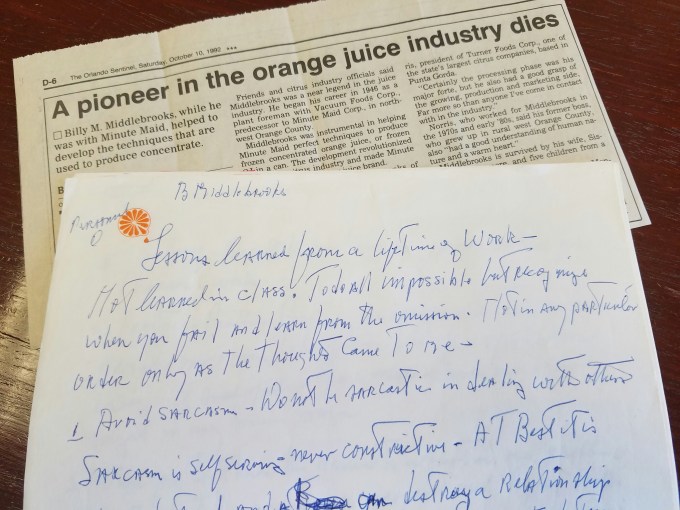
Fast forward 25 years, and I decided to create my own set of lessons I’ve learned along my path in the business world. Some were shared with me from my father, and some were formed directly from his very hard to read notes! Some of these lessons I learned from other leaders and mentors, while some were simply acquired the old-fashioned way … by having them beat upside my head!
These are not presented from least important to most important. They’re not even in order of when I’ve learned them. They are purely provided for your reading enjoyment in the order they popped into my head. In the description of this blog, I warned you about my non-sequential brain!
Here beginneth the lessons …
Lesson 1: Avoid “They”
Never say, “They Said.” Do not pass off responsibility for decisions on some other faceless entity. As a manager and leader, the company position is your position. Never say, “They said ….” The faceless “They” is ever-present in most companies. At Coca-Cola, people love to say, “Atlanta said”, or “Leadership said.” I’ve always found this approach weak and a cop-out when leaders do it.
-
If you cannot be the executor and supporter of the decisions of your company, you should get out. As a manager, you are in charge, and when it is necessary to pass through instructions or policies, it should be clear that these are your policies and that you fully support the action requested.
Direction should be provided as “Here is what we need to do” or “Our policies are …” That certainly doesn’t mean that every directive that comes down from above must be blindly accepted and passed down. Debate and challenge if appropriate. Raise your voice and share your feelings on issues, with YOUR manager or YOUR leadership. However, after that debate and period of challenge, if the company policies stands, you as a leader are responsible for communicating that policy. Do so with conviction and ownership. Passing off direction as really belonging to someone else, or the proverbial “they,” weakens your role with your associates and those who follow you.
If you rely on “they”, you truly are just the messenger. Be a leader.
Lesson 2: “Say so!”
-
If you don’t know the answer to a question, say so!
This is one of the most common mistakes I see people make. They are simply afraid to be seen by leaders as someone who doesn’t know the answer to a question. So, what do they do? They make shit up!
When you don’t know the answer to a question, say so. Get the answer, if appropriate, and report back. Giving an incorrect response will be recognized, and repetition will, in time, identify you as a person who cannot be trusted to be correct. Responsiveness and a bias for action will always win out as attributes over eloquent obfuscation. It may feel better to provide a learned and eloquent response signifying nothing, but over time getting things right prevails.
Lesson 3: “Never, ever, knowingly drop a ball!”
This might be my biggest pet peeve in business … the person who sees a problem developing, and lets it happen because it’s “not their job” to deal with it. Letting a negative event happen just because you don’t feel it’s your job to address it is the ultimate statement about a lack of commitment to the enterprise.
-
If there is a genuine need, fulfill that need even if it exists outside of your specified role.
-
THEN, figure out whose role should address that need going forward.
When you are a member of an organization, whether that be a family, a partnership or a corporation, you have an obligation to help that organization grow and flourish. You can’t uphold that obligation by letting bad things happen when you have the ability and opportunity to prevent the bad thing from happening to begin with.
Step up. Pick up the ball. Run with it. Pick your metaphor, but take action. Once the issue is resolved, work with the organization to fix the process so that the responsibility for future occurrences is clearly defined, and the risk of future occurrences is mitigated.
Lesson 4: “Do something about it!”
-
You choose your own attitude … every day! If you’re not feeling good about your work environment, or your job, do something about it!
This is a tough one for me and for so many people I know, but it is so critical for success, and, more importantly, enjoyment in the workplace. It is so easy to get down about your job, your place in the organization, and about life in general when things don’t go your way … when your boss calls you out because you missed a deadline or didn’t deliver against expectations; when a presentation isn’t received as well as you’d hoped and after you worked long hours on it; when you are passed over for a promotion, or you don’t even get a shot; when someone clearly not as experienced as you gets the job you were hoping for. Do any of those sound familiar?
When one of those, or dozens more, “downer” events hits us in the workplace, it is very easy to slip into a funk of mediocrity. Often, we don’t even realize we’re in that funk. We just back away a bit, or don’t quite bring our whole selves to the office each day. Hell, after 28 years with my company, there are days where I slip into the “don’t I deserve a day or two of partial effort?” mode.
The reality is, though, that the only person who can get you out of your funk is you. You choose your own attitude, every day. So when you feel that slip start – and you do feel the slip if you are being honest – then figure out what your trigger is to get back in the game. I am motivated by wanting to leave behind a positive impression on those I work with, so when I feel myself slipping, I think about how that version of myself will be perceived if I continue in that space. For others, it may be that they need to take on a project to change their perspective. Maybe you just need to take a personal day to get your head in the right place.
Whatever that method is for you, however, find it, use it, and remember it! I can promise you that you’ll need it again in the future. You’ll feel the slip creep in … the funk of forty thousand years! (song reference?) … and you will need to access your method to get back in the game.
Lesson 5: “Learn how to present”
-
The ability to present ideas is one of the most critical skills you can obtain. Practice it like you would any other important skill.
Have you ever seen the quote, “Everyone lives by selling something”? I think it’s Robert Louis Stevenson … or Mark Twain … but I think it’s Robert Louis Stevenson. I believe this quote is mostly true. At Coca-Cola we like to say, “you’re either selling Coke, or you’re helping someone sell Coke!”
What is true in this world is that you have to be able to communicate your thoughts and ideas to be heard. I guess in a perfect world, everyone would listen so perfectly and so without bias that the method of communication would not matter. The message would come through regardless of the medium. But that’s not the case. People hear through their own bias, their own noise, their own distractions and their own attempts to finish your sentences and guess where you’re going! (you know you do that too!)
Therefore, you need to learn how to present! Whether via slide shows and in front of groups, or via one on one discussions, you need to figure out a balance of your own personal style and a compelling narrative. One tried and true method is the ever popular “tell me what you’re going to tell me, tell me, and then tell me what you told me”, a.k.a. Introduction, Body, Conclusion. That’s a clever mnemonic device (and it actually does work) but what I’m really talking about is that you need to find your own approach. For some people, using humor is a terrible idea (don’t attempt unless you’re a professional). For others, clever anecdotes can be a great device to pull in the listener(s).
Style is less important that situational awareness. Learn to read the situation and the audience, and adapt. That means preparing, thinking about the motivations of your audience, and catering your message AND your style. It really is a balance.
Practice this skill with people you trust, and, importantly, people who will give you honest feedback. Nothing is more damaging that the trusty friend who tells you you’re awesome when in reality you suck! Learn how to present, and you’ll be more effective in everything you do.
Lesson 6: “Be on time”
We’re not exactly sure of the origin, but one of my best friends and a great leader in our organization uses the following expression: “Early is On Time, On Time is Late, and Late is Unacceptable!” I love this! It’s catchy, it’s easy to remember and it is 100 percent true. Whether in your personal life or at work, nothing communicates a lack of empathy and respect like showing up late. The harsh reality that most people resist, however, is, 90 percent of the time, if you are late, it’s because you didn’t care enough to be on time.
Here are the most common reasons for being late, and why I feel they are most often inadequate excuses:
- My previous meeting ran late. This is a tough dilemma I admit. And it happens a LOT at my company. By staying late in the one meeting to BE late in the next, however, you are choosing to respect one party more than the other. There are a lot of reasons you will have to make that choice … politics, personal satisfaction or interest in the subject, personal preferences for the people in the meeting, and many others. You need to be honest with yourself when you make that choice, however. Don’t say “It was out of my control.” The reality is you can AT LEAST ask for a moment in the current meeting to contact the person you are going to be late for to inform them. I am constantly amazed when people rush in to a meeting late, and immediately exclaim, “I’m so sorry I’m late. I was in another meeting and I couldn’t get out.” There is so much wrong here! Here’s what the meeting organizer and the other people in the room are hearing … I had something more important to deal with … or, I was with someone more important that you … or, I was so caught up in my own stuff that it didn’t even occur to me to call or text you! Don’t be that person. If something unexpected comes up, make every possible attempt to notify the meeting organizer. Just walking in late with no better excuse than I was doing something else will cause you to lose a little respect. Don’t be that guy!
- I got stuck in traffic. I’m certainly not going to pretend this never happens, especially living in Atlanta! In all honestly, however, it happens to some people way more often than it should. This is a lack of planning, pure and simple. If you only allow yourself time for the perfect commute time, you are not caring enough for the others in the meeting. If you have committed to attending a meeting, then you need to commit to planning your travel to get there on time, even if that means waking up an hour early and getting in early. If that’s not possible, and you have other commitments, then say so when you accept the meeting and see if a dial in option could work as a backup, or seek a better time. If you decide to push your luck, and you are late, it’s disrespectful. Don’t be that guy!
- Something came up a.k.a. My boss dropped an urgent project on me! This is really just an extension of excuse number 1, but with even LESS of an excuse to not contact the meeting organizer. If your boss really does drop an urgent project on you, and you have a meeting to go to, explain that to your boss and make sure he/she really wants you to bail on that session to attend to the project. If that is the case, call the person you are meeting with, or, even better, walk down and see them face to face, and explain the situation. Too often, people begin to use this excuse just to avoid meetings or to create an actual reason for being late. Don’t be that guy!
-
Early is On Time, On Time is Late, and Late is Unacceptable!
Being on time requires an effort. It’s actually hard work. Most importantly though, it demonstrates that you are someone of respect, that you are well-organized and conscientious, and that you can be relied on. When I’m making hiring decisions, those are traits I value and seek.
Lesson 7: “Clarity is more important than quantity or brevity”
Let me be clear that I fully understand the irony of my saying this as I ramble my way through this blog! However, this is NOT a business communication. So, on with the lesson …
-
Be clear in your communication. That is your goal!
Too often, I receive two kinds of emails, and both are frustrating. First is the email that goes on and on and places the onus on me to figure out what are the critical takeaways and action steps. Second, is the email that is so short that I don’t get enough information thus starting a Q&A session via email back and forth.
Let’s start off by addressing some email etiquette.
- I am a BIG fan of putting the type of email you are sending in the subject line. Put ACTION, or INFORM as the first word in the subject line to tell the receiver if you are simply sharing information or requesting some action or response.
- While we’re talking about subject lines, don’t use “REPLY” or “FORWARD” and then start an entirely different topic in your note. Change the subject line!
- Don’t send “Thank you” or “Okay” as a reply. I get enough emails. Having to delete another one unnecessarily just countered any good will you intended to gain by sending it in the first place!
- Always include a signature … It’s easy to do and makes it much easier for people to be able to find you instead of having to look up your contact information.
- Don’t use “Auto Reply” unless it’s really important or you’re going to be away for a lengthy time and you need to redirect your work. Again, I get enough emails that having to delete all of the auto replies letting me know that “you are in a meeting and will get back to me as soon as possible” are nothing but aggravating! I assume you will get back to me as soon as possible. That’s what we’re supposed to do.
- Don’t email angry AND add the email addresses last! These two tips work hand in hand. If you feel your blood pressure rising as you are typing your email, walk away. Do a lap around the floor or building. Go grab a beverage. Check Facebook. Do something, but STOP TYPING. I can promise you, the short-term pleasure you feel typing your perfectly worded BURN email, will not offset the damage you are about to do by pressing SEND. Adding the email addresses last to an email helps avoid the premature send!
- Please, for the love of all things good in this world, DO NOT USE REPLY ALL to messages from IT, or HR, or LEGAL! Nothing more needed here.
There is an art to sending effective emails, but since it has now become the most common form of business communication, work at it! Be clear in what you are doing. Highlight requested actions and due dates. Get to the point but don’t be so brief that you invite additional questions for context.
Lesson 8: “Make it work”
Make what you have work, whether people, structure or machines. Changing any one is not productive as a first recourse. Problems usually lie within process, system, or training … things that you can control. These will still be the problem after a restructure, or people are replaced. There are times when people need to be replaced. They are in the wrong roles, or lack the skills or temperament for the job. There are times when a department needs to be restructured because the business has shifted, or clarity and efficiency can be gained in that work. However, more often than not, gaps lie in process design, systems or training. Leaders need to analyze these areas first, before jumping to people or structure. When I see departments with continuous churn and restructuring, I am confident there are either process and training issues being neglected, or some kind of serious strategy gap.
-
More often than not, gaps lie in process design, systems or training
- We have gone through more restructurings at my company than I can count at this point. When you find yourself in a cycle of constant restructuring, it is highly likely that you are not addressing some root process issues. Putting structure first, is like buying the latest technology with no user manual. You are the proud owner of the latest thinking, with no idea how to make it work. Have you ever bought a new appliance with a crappy user manual? We bought a new microwave, and it was burning the hell out of our microwave popcorn when using the POPCORN button. The manual was horrible and didn’t address how to adjust the preset buttons at all. I finally found a fix by looking online. A weak manager would have just replaced the microwave!
A part of this lesson is also to learn to work the equipment you have. Learn how to use your computer and its programs. Understand the technology you use frequently (projectors, cell phones, conference call systems, etc.). Think about how many meetings you’ve been involved in where the leader is stuck standing there saying “I’m sorry we’re having technical difficulty. We’ll get started in 5 minutes.” How did you feel about that session? I bet not one of those meetings is memorable or inspiring to you. Don’t let a lack of technical proficiency detract from your message as a leader.
Lesson 9: “Performance, Enjoyment and Learning must all be present in a high performing team”
The “P-E-L” Triangle has been used by motivational speakers, leaders and writers so often, I’m not entirely sure where it came from. My first memory of it is from “The Inner Game” books from Tim Gallwey, I think! I find this simple model to be so true, though. Effective teams, families and groups all share the triangle in common. They all maintain a balance between Performance (P), Enjoyment (E), and Learning (L). All three elements must be maintained to be truly effective.
-
Effective teams, families and groups all share the triangle in common.
Performance is fairly obvious. We’re in business to deliver results. Repeating that delivery is the challenging part. If you find a team that is delivering results year after year after year, the chances are very high that they have the P-E-L triangle working in balance. That team is having fun. Delivering results is fun in and of itself! But this is deeper. They enjoy working together. They have discovered some level or work/life balance. They have become comfortable with one another and are speaking without fear of repercussion, and they’re using humor. And finally, to repeatedly deliver results, they are getting better, which means they are learning. Effective teams learn from each other and from watching other high performing teams to learn from their successes and failures. They learn through training, both formal and informal, and they learn by taking accountability for their own individual development. More on this last one later.
The P-E-L triangle may be over used, but there’s a reason it is … because it’s true. I’ve never been a part of a great team that I don’t remember as winning, progressing and fun. Great leaders figure out how to enhance all three sides of the triangle.
Lesson 10: “How you do things is as important as what you do”
I once heard a very senior leader stand up in front of the organization and say, “Results are the only things that matter. We are paid to deliver results. I don’t really care about the hows. I only care about the whats!” I remember so vividly feeling a little sick and sad as soon as he said it. It was honestly the first, and only serious, time I considered leaving my company. You hear this in sports, too. Winning isn’t everything, it’s the ONLY thing! That quote is attributed to UCLA basketball coach Red Saunders, as well as to Vince Lombardi who repeated the quote on occasion.
The idea that how doesn’t matter is a horrible mentality to have in business. It breeds selfishness and even corruption. People will trade civility for expediency and the values of your organization will shift away from valuing diversity of thought. There is no time for that when results are the only things that matter. If you ever feel that you are doing things the wrong way to deliver the results expected of you, you should consider finding something else to do. You can lose yourself in that kind of environment.
That leader only stayed with our company for a few short years, and I was in a role where his views of “hows don’t matter” didn’t impact how I managed my team. I also read that Vince Lombardi, late in his life expressed that “I wished I’d never said the thing…I meant the effort. I meant having a goal. I sure didn’t mean for people to crush human values and morality.”
-
You see, HOW you do things matters as much if not MORE than WHAT you do.
How you do things is where your humanity is found. It turns a business into a social entity. You remember people in life from what you learned or experienced with them. You remember with fondness great leaders for how they made you feel, how they treated you, AND for the results that came along with it.
Lesson 11: “An Open-Door Policy doesn’t work if there is a jerk on the other side of the door”
The ever popular “Open Door Policy”. “My office is always open. I want to hear from you.” The ironic thing is that if a manager has to tell you his door is open it’s probably because the door is figuratively closed most of the time. In order to actually have an open-door policy, you have to mean it, and care about the importance of open communication with your associates.
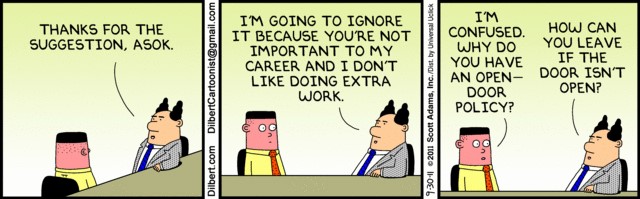
Spend time actually outside of your office. Walk around. Step into their office spaces from time to time. Ask questions. See what they are working on. And most importantly, be responsive to their requests. I’m not always as consistent as I need to be on the last one. I allow myself to get pulled into the inertia that is “managing up” or at least “managing the matrix!” Constant project meetings, task forces, communication routines, etc. take up an inordinate amount of time on most days, which means less and less time to focus on my associates’ needs. I find myself focusing completely on them in spurts. I convince myself that at least I do that, but the truth is, the best leaders make their employees feel like they are the most important thing in the day.
Lesson 12: “You are responsible for your own development”
A company, or a manager, cannot develop you. It is just not possible. Think about your own kids, or the kids you knew in school. Which ones excelled in their classes? Only the ones that had excellent teachers? Did the accomplished students get extra time with their teachers and they just poured their knowledge into them? Of course not. The great students were the ones that studied, or were able to make connections to the material in ways that allowed them to retain the knowledge and then apply it in homework and exams.
The students that didn’t do well either didn’t study or could simply not make the connection to the material. For me, once imaginary numbers became a thing, I lost connection to my math classes and started to struggle!
It’s the same in business. The people who excel are those that take it upon themselves to study and to make connections to the material. They learn through classroom training, by reading books and articles, and by spending time with others in the organization who can help them … mentors and successes in their areas of excellence. One of my favorite quotes is from George Bernard Shaw. I keep a plaque of it on my desk … (Side note – I only learned of the quotes’ origin in recent years, and it actually makes the quote even more poignant … Source: George Bernard Shaw, Mrs. Warren’s Profession, Vivie Warren in Act II)
-
“The people who get on in this world are the people who get up and look for the circumstances they want and if they can’t find them, make them.”
Management is responsible for providing tools and the environment for development. A manager’s role is to support and assist associates in their development plans. However, in the end, you are responsible for your own development!
Lesson 13: “Choose your next position with an eye to the one after that”
People often come to me at work to ask my opinion of a job opportunity they are considering. They want to know if I think it’s a good job for them to go for. I am very consistent in my next question.
-
What job is that position preparing you for in the future?
Too often that is not a question they have considered. Each position should be viewed as training for the next job. To figure out if a job is right for you, you need to have an idea of where you are heading in your career. Positions don’t have to be completely linear, as in within the same reporting structure. I do believe, however, that they should be complimentary. Each job should add skills to your portfolio to better prepare you for the next job on your path. I feel it’s a mistake to go for a job just because it sounds interesting, or exciting, if you don’t have an eye to the future. You might trade a short-term interest for a long-term career path.
Of course, the trick here is to have an idea of where you want to head in your career. Don’t feel pressure to know the exact position, but get comfortable with the type of work you want to do … Customer Facing, Sales, General Management, Functional Expertise, Marketing – Brand, Commercial or Partnership/Alliance. Figuring out the type of work you want to do will lead to the type of position you ultimately want to shoot for, and therefore clarify the path before you. Don’t worry about the next job until you clarify the longer-term goal. It will make your career decisions easier and more productive.
Lesson 14: “Effective Leadership means leading others to lead themselves”
Years ago, a young manager came to meet with me very concerned about her ability to manage one of her associates. “He’s better than I am now,” she said. “There’s nothing more I can teach him.” I remember coaching her that she was confusing leading and teaching. I couldn’t do her job as well as she did it. Why should she expect that she could do his job as well as he did it? How many great sports coaches can take the field and outperform their players?! Just because you, as a leader, cannot teach technical skills to your associates that they don’t already know does not mean you can’t be effective. Teams need direction, coaching, inspiration and effective questioning to lead to procedural improvements.
-
Managers direct, teach and control. Leaders build teams to lead themselves, by instilling belief, direction and conviction into the team members themselves.
I think the ability to create “leaders of self” is a critical skill for today’s organizational leaders to have. More and more, the people we manage are in different locations, scattered across the country or globe, often working isolated from home offices. If you, as a leader, cannot build the ability for your team to lead themselves, your team will fail. Modeling work ethic, learning to ask good questions, and getting creative in how to check in on associates without policing are among the soft skills needed for today’s leaders.
Lesson 15: “Learn to listen, and you’ll learn to love”
Have you ever heard the saying God gave you two ears and one mouth, so you should do twice as much listening as speaking? It may have come from James 1:19, “Wherefore, my beloved brethren, let every man be swift to hear, slow to speak, slow to wrath.”
Too often in business, we do not follow this approach. We use judgmental listening. We hear people talking and we are judging … from HOW they are saying things, to WHAT we would be saying if we were in their place. To be effective, leaders must use empathetic listening by trying to hear the message through the speakers’ ears, and see the message through the speakers’ eyes. There are some great books and articles about listening. Most address the bias that we all listen through. We listen, primarily, with the intent to respond. So, we immediately begin to craft our response. That’s why we drift off while we “listen” to people. We begin to think about how clever a response we will make or exactly how we’re going to zing the other person. “If I say this, they’ll really be impressed!” The author, David Augsburger, has a great quote:
-
“Being heard is so close to being loved that for the average person, they are almost indistinguishable.”
Think about the stereotypical used car salesman. He doesn’t care what kind of car you want, he’s got the car for you! If you don’t listen empathetically to your associates or peers, how do you know what kind of car they want?
Here endeth the lessons!
I hope you found them helpful, or at least thought provoking. What lessons have you learned along the way? Share them in comments below.
 Thoughts from the Middle
You should team up with Pat Flynn and let Gil illustrate it and turn it into a book. I’m going to print this out and use it when I have to do presentations.
LikeLiked by 1 person
Thank you, Doug. Outstanding list and true of their author.
LikeLiked by 1 person
Fantastic article from an outstanding former manager, trusted colleague and great friend! Thank you for sharing. These are great life lessons for everyone to follow.
LikeLiked by 1 person
Thank you for sharing. These are all excellent lessons and I appreciate your advice. I’ve identified 15 opportunities for improvement in my professional development. Tried and true, I appreciate you passing along what you have learned.
LikeLiked by 1 person
Awesome and meaningful advice! Thank you for thinking enough of others to share your wisdom.
LikeLiked by 1 person